An asking price is one person's opinion with a number attached. A sale price is what a buyer with a budget actually paid. Those two figures get used interchangeably in domain writing, and the substitution is where most bad valuations begin.
Here is the first thing we owe you: our database records realised prices. We do not systematically record the asking prices that preceded them, so we cannot compute a median discount, and neither can anyone else who tells you asking prices for .si sit a fixed percentage above sales. That number would be invented. What the receipts do show is how wide realised prices really run, and how much of the range is decided by the room the name is sold in rather than by the name.
What the tracked sales show
| Measure | Value |
|---|---|
| Tracked .si sales | 285 |
| Median | $2,500 |
| Average | $4,332 |
| Lowest recorded | $95 |
| Highest recorded | $50,000 - staffing.si, Spaceship |
A 526-fold spread between the smallest and largest sale is not noise; it is the shape of the market. The median sits at $2,500 while the average sits at $4,332, so a small group of five-figure names is doing the pulling. Any listing that quotes "the .si average" as an expectation is using that tail to describe a name that is probably not in it. The sales index prints the underlying rows if you want to test that yourself.
Where the real gap lives: between venues, not between numbers
The strongest evidence in our data is not a gap between an ask and a sale for one name. It is the gap between the channels names are sold through, in the same extension and the same year:
| Channel | Sales | Average | Highest |
|---|---|---|---|
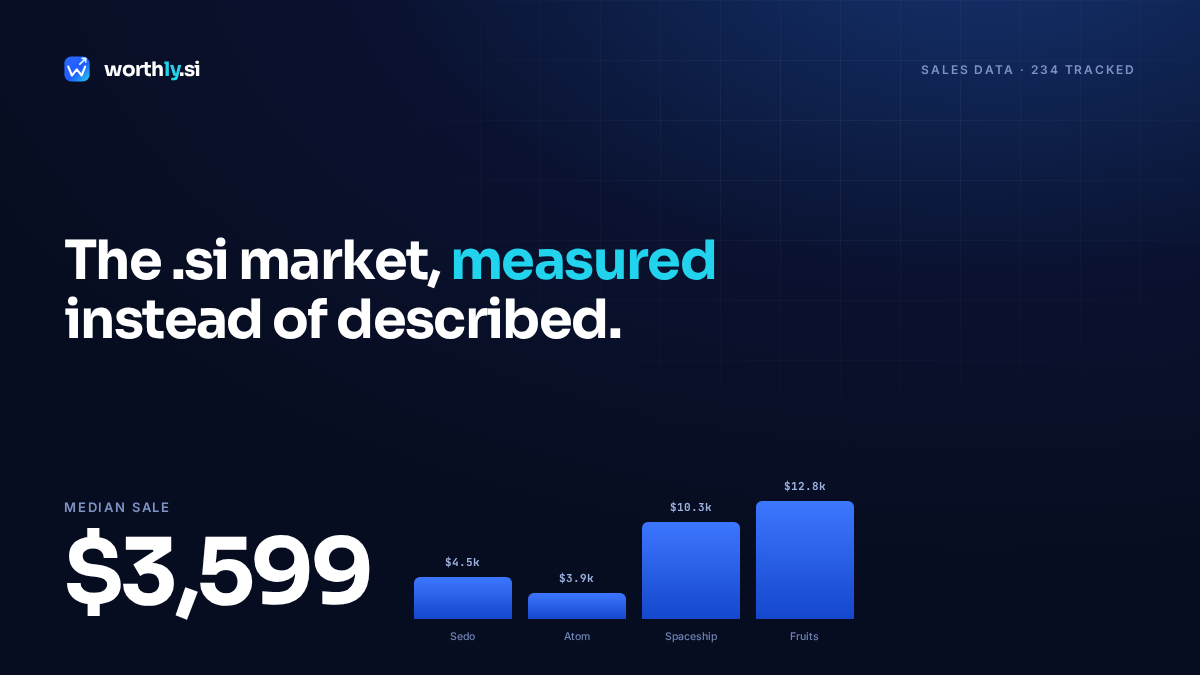
| Fruits (curated) | 10 | $12,784 | $31,346 |
| Spaceship | 15 | $10,318 | $50,000 |
| Sedo | 48 | $6,178 | $30,000 |
| Private | 20 | $3,027 | $23,000 |
| Atom (weekly auction) | 77 | $1,877 | $14,870 |
| Auction, venue unnamed | 10 | $532 | $2,000 |
The mechanism is not mysterious. An open auction ends when the second-highest bidder stops, so it clears near the floor of the room that showed up. A curated or brokered sale ends when a buyer with a specific use for the name agrees to a price, and it can take a year to find that buyer. The same name can therefore produce a $532 result in one channel and a five-figure result in another. Our own records for caspian.si ($20,000) and healthy.si ($23,000) sit in undisclosed and private channels rather than in open auctions.
The cost of misreading this is symmetric, and both directions hurt. Read only the auction rows and you conclude that .si is a few-hundred-dollar market, then sell your name far below what a targeted buyer would pay. Read only the curated rows and you conclude that $12,784 is normal, set the listing there, and wait indefinitely for a buyer who is comparing your name against $2,500 receipts.
How we read a listing
- Ask for tracked comparables, not adjectives. "Seven-figure potential" is not information. "Six-character .si names average $3,822 across 43 tracked sales" is. If a seller cannot point to rows in a public index, the price is decoration.
- Check whether the price is an ask or a record. A buy-now figure is the seller's anchor. Only a registry-verified ownership change tells you a transaction happened at all, which is why we read RDAP rather than listing pages.
- Ignore comparables from other extensions. A six-figure
.comsays nothing about a.siname. Different buyers, different budgets, no substitution. - Treat "make offer" as uninformative rather than dishonest. Our own listings page works that way: owner-verified names with Atom make-offer links and no posted price. You learn the number by making an offer, which is honest and still tells you nothing about what the name is worth.
- Price the hold. Renewals on an ordinary .si name run roughly $11-30 a year, and there is no registry privacy protection, so registration data sits inside EU identity matching. An asking price means nothing if the buyer who could use the name is not in the room.
Where our data is too thin to conclude anything
- No ask-to-sale ratio for .si. We do not record asking prices, so we cannot measure the discount. Anyone quoting one for this extension is extrapolating from .com.
- No per-venue medians. We can publish counts, averages and maxima. Below about 20 sales a venue, an average describes a few events rather than a benchmark.
- 88 of 285 sales name no venue at all, and they average $4,577. We cannot tell which channel produced them, so we cannot tell whether the price came from an auction floor or a negotiation.
- No renewal tiers. We record sale prices, not the renewal band a name carries afterwards, so we cannot quantify how much of a cheap-looking price comes back at renewal.
We would rather print the gap in our knowledge next to the numbers than fill it with a plausible figure. Our method and its limits are set out on how the checks work.
The one-line version
An asking price tells you what a seller wants; a tracked sale tells you what a buyer paid; the difference between them is the seller's patience, not the name's value. Read the receipts, ask which room they came from, and be suspicious of any number that arrives without one. If you want a range with its arithmetic shown, the appraisal prints the comparables it used for any .si name, free and without an account.
Figures reflect the worthly.si index as of 15 October 2026 (285 tracked sales); the live index is on /sales.
Check a name while you are here.
Registry-accurate availability and a value range that shows its comparables — free, no account.