You own a .si name and someone asks what you want for it. There are three common answers — a fantasy number from a blog post about .com, a shrug, and a method. This is the method.
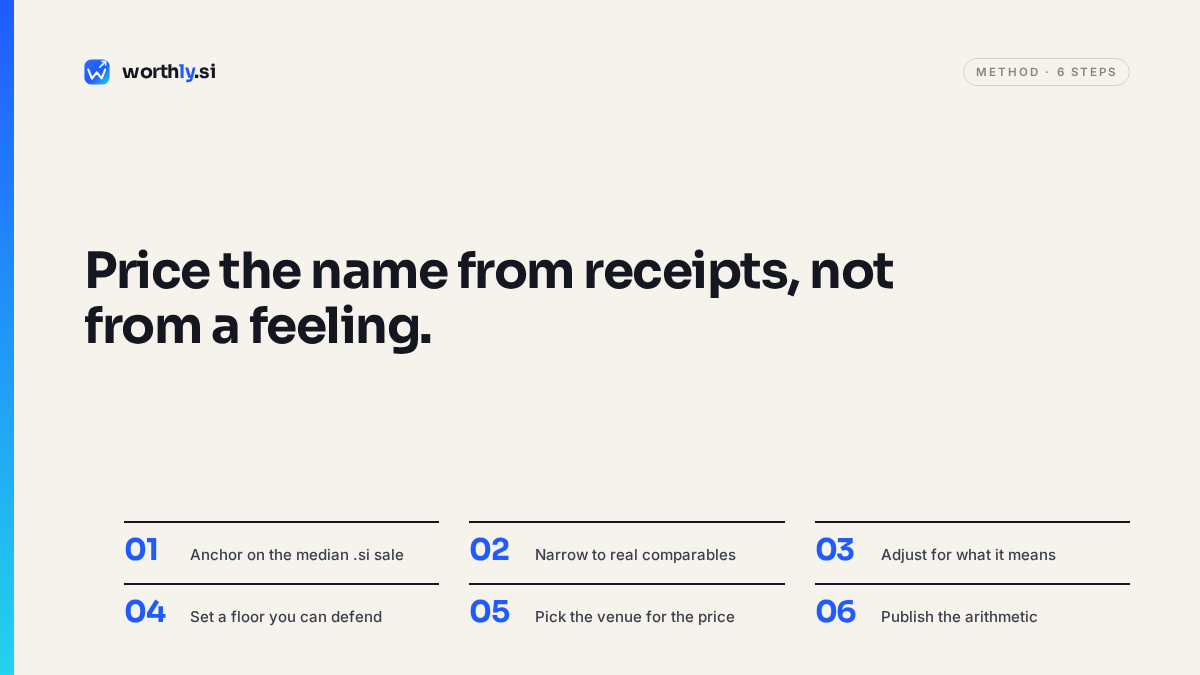
Step 1 · Start from the median, not the dream
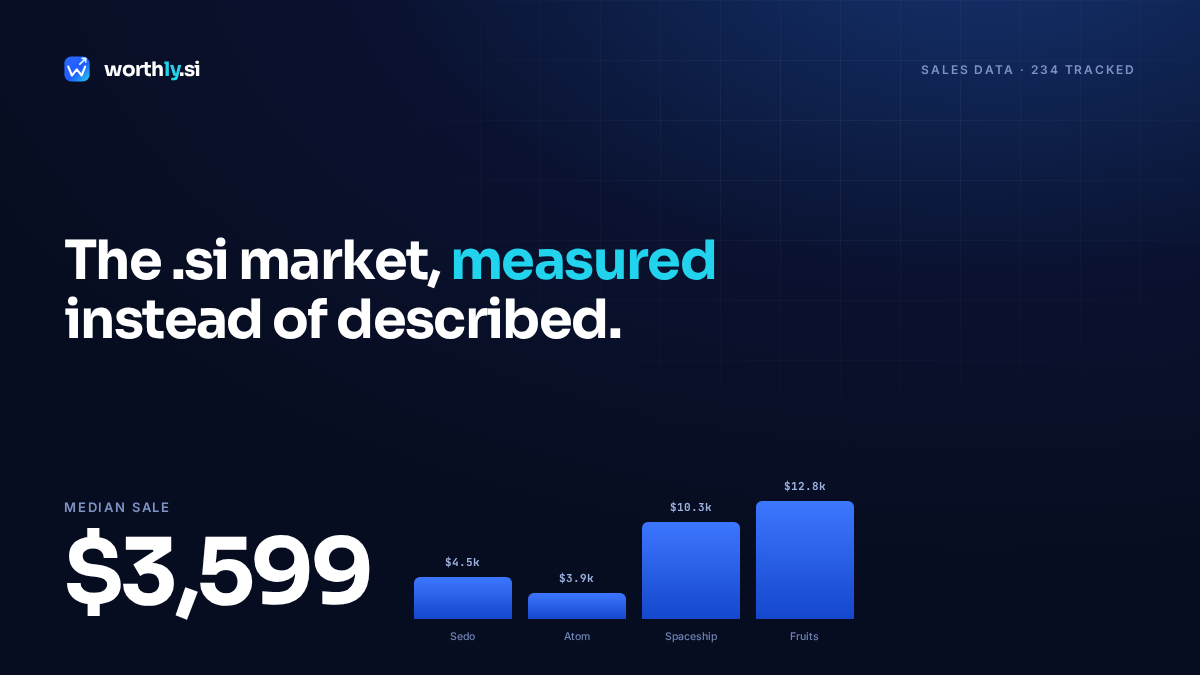
Across 285 tracked .si sales the median is $2,500 and the average is $4,332. Open at the median and you are describing the real middle of the market. Open at the average and you are pricing yourself against a tail of five-figure deals that most names never join.
Step 2 · Narrow to comparables before you adjust anything
A comparable is a tracked .si sale that a buyer would recognise as a substitute for your name. Ours are matched on three things at once: similar length, the same category (service, dictionary word, invented word), and whether the name carries commercial intent. Two-word phrase valuations pulled from .com comparables are not comparables; they are decoration.
The question is never "what did a domain sell for?" It is "what did a domain like this sell for, to a buyer like mine?"
Step 3 · Adjust for what the name is
Four signals move a .si range more than anything else:
- Category. A word a business needs (
excavators,chauffeurs) is worth more to one buyer than a short string is to anybody. - Extension coverage. If the same word is already taken in
.com,.ai,.ioand.co, the online business exists and is already paying for names. That helps. - Invented vs. real words. An invented string in a two-letter extension is a brand for a startup that has not been founded yet; a real word is a brand for a business that already exists.
- Length. Weak on its own — measured, .si averages sit between $3,800 and $4,300 from three to six characters, rise from seven to ten, and fall away for the longest strings.
Step 4 · Set a floor you can defend in one sentence
Your floor is the number below which you would rather keep the name. Write down the sentence that justifies it before you list. "It is the only two-letter .si word for this market, the .com is a $40,000 name, and renewals cost me $11 a year" survives a negotiation. "It feels like a $10,000 name" does not.
Step 5 · Choose the venue for the outcome you want
Volume channels move names faster at lower prices; curated channels take longer and clear higher. In the tracked data, Sedo averages $6,178 across 48 sales, while private sales average $3,027 and undisclosed ones $4,577 — the same names, different rooms.
Step 6 · Publish the arithmetic next to the price
Buyers argue with numbers, not with adjectives. When a listing says median .si sale $2,500 · up to 6 comparables · this name is a service word with full extension coverage, the conversation starts from evidence. That is exactly what our appraisal page prints for any name, and what the sales index shows for every tracked venue.
Three mistakes that cost money
- Pricing from .com comps. A $250,000 .com does not make the .si worth a tenth of it. Different buyers, different budgets.
- Ignoring renewal cost. A $11-a-year name is cheap to hold; that patience is an asset, so do not dump it in week one.
- Accepting the first offer because it beats your floor. A floor protects you from a loss, not from leaving money on the table. Ask the buyer what they are building — the answer usually moves the number more than any argument about the domain.
If you would rather see the range before you set a price, run the name. It is free, it needs no account, and it shows its work.
Figures reflect the worthly.si index as of 15 October 2026 (285 tracked sales); the live index is on /sales.
Check a name while you are here.
Registry-accurate availability and a value range that shows its comparables — free, no account.