Atom runs weekly auctions that include .si names, and its results feed the database behind our tracked .si sales index. Atom is a partner venue we record, not an employer: nobody there reviews this article, and we have no commercial reason to talk you into bidding. That matters, because most of what follows is about the ways venue data misleads people who read it too quickly.
What our Atom data contains, and what it does not
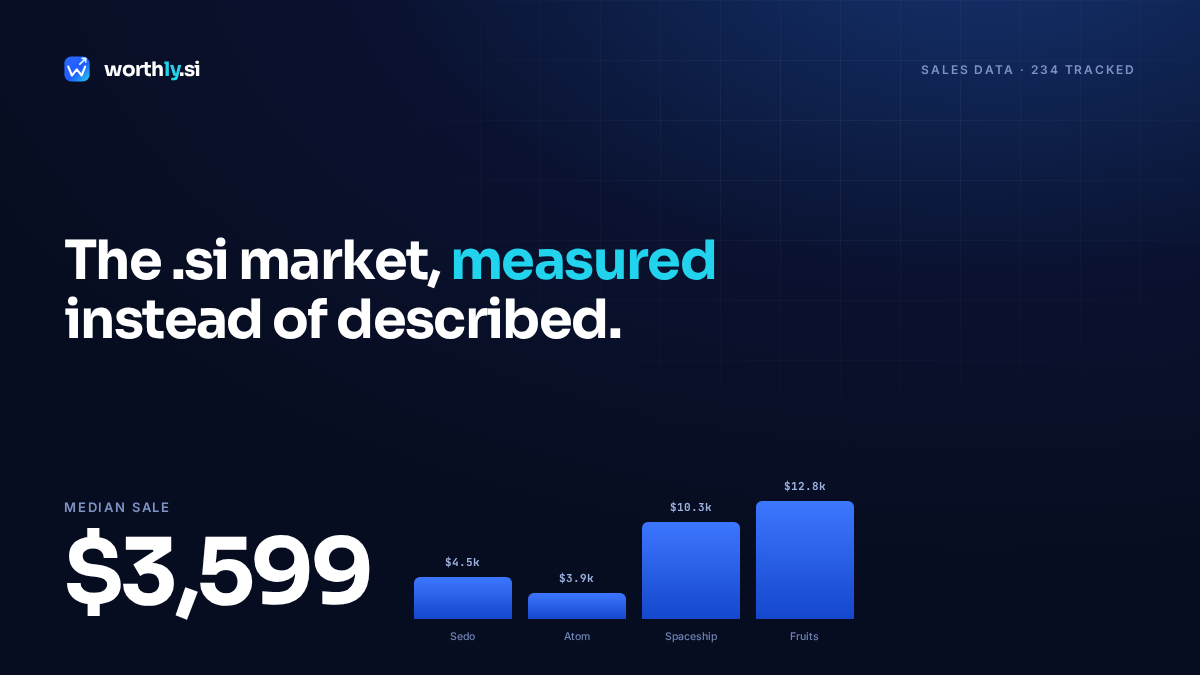
Across 234 tracked .si sales, 27 are attributed to Atom. They average $3,904, and the highest reported result is $14,870. The full dataset has a median of $3,599 and an average of $5,085. Atom therefore sits in the middle of the .si market by average: above the open-auction end, well below the curated end.
| Venue | Sales | Average | Highest |
|---|---|---|---|
| Spaceship | 15 | $10,318 | $50,000 |
| Fruits | 10 | $12,784 | $31,346 |
| Sedo | 48 | $6,178 | $30,000 |
| Not stated | 87 | $4,565 | $20,000 |
| Atom | 27 | $3,904 | $14,870 |
| Backorder auction | 6 | $3,468 | $5,800 |
| Private | 20 | $3,027 | $23,000 |
| Dynadot | 8 | $2,363 | $7,250 |
| Auction (venue unnamed) | 10 | $532 | $2,000 |
| Dynadot auction | 3 | $858 | $1,075 |
Look at the row labelled Auction. Those ten sales average $532 with a maximum of $2,000, and our records do not name the venue. We do not attribute them to Atom and we will not pretend they are Atom data. They are in the table because they show how low an open auction can clear when the room is thin, which is the risk you accept by bidding in one.
Five things we do before placing a bid
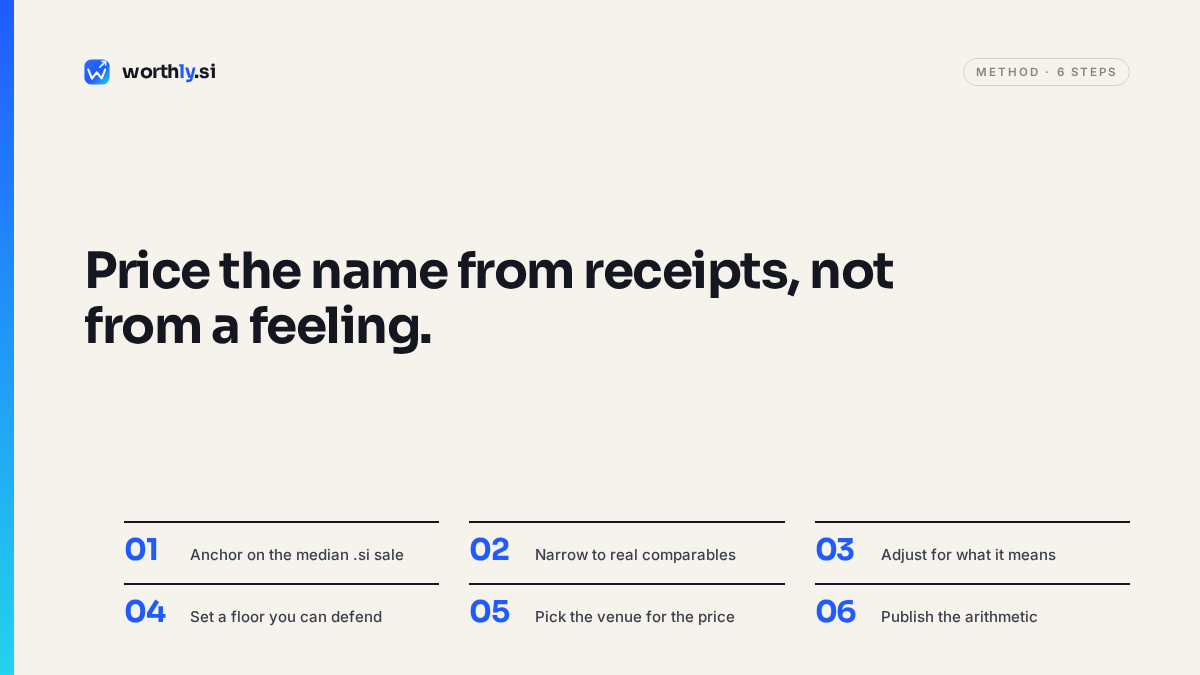
- Verify the name at the registry ourselves. An auction listing is a claim about a name; ARNES is the authority. We read the registry record through its public RDAP endpoint and cross-check DNS before valuing anything. Our method for that is written out on how the checks work. If a listing describes a name whose registry record does not match, stop there.
- Name the buyer in one sentence. Not the category, the buyer. "A Slovenian HVAC installer that wants its exact service word for search" is a sentence that constrains your bid. "Good keyword" is not.
- Write the ceiling down before you watch bids move. Auction pressure is a real cost. A number decided in advance is the only bid you will not regret.
- Compare against the median first, the top row last. Median .si sale, $3,599. Any bid above that is already above half the market.
- Price the hold, not just the hammer. A win is a binding purchase. Renewals on an ordinary .si name run roughly $11-30 a year, and the registry offers no privacy protection, so registration details sit inside EU and NIS2-era identity matching. Those costs are small but permanent.
Price discipline: anchor on the median, not the top row
One $14,870 result inside a 27-sale sample is enough to lift Atom's average on its own, which is exactly why an average drawn from a small, skewed sample makes a poor ceiling. The rule we use: the ceiling is the highest comparable sale in the same category, not the highest sale at the venue. If the only justification for a bid is that one Atom name cleared $14,870, you are bidding against an anecdote rather than a comparable.
We also treat the median as the exit reference, not the entry one. Buy at the median and you need a buyer at the average to make a margin, before any fees. In a market this thin that is a hope, not a plan.
What the venue data cannot tell you
- Reserves and starting bids. Our records store domain, price, venue and reported date. Nothing about the reserve, the number of bidders, or whether a result was an auction win or a direct offer.
- The pass rate. We do not know how many Atom .si auctions ended without a sale, so 27 tracked sales is not a share of anything. Any clearance rate you see quoted for .si auctions is coming from somewhere other than this dataset.
- Per-venue medians. With 27 Atom sales we can report a count, an average and a maximum. A median would be more honest and our snapshot does not carry it, so treat $3,904 as a rough centre rather than a benchmark.
- Anything about momentum. 197 of the 234 sales are dated 2026 and 37 have no date recorded. We cannot build a reliable month-over-month trend from that.
We say all of this plainly rather than presenting $3,904 as a target. It is a description of 27 events.
The cost of being wrong
Overpaying at an auction is the cheap mistake, because it is bounded and you know the number on the day. The expensive mistake is winning a name you cannot afford to hold. The entire tracked .si aftermarket is 234 sales across every venue we can verify. That is a market clearing tens of names a year, not thousands. If your plan requires an exit within one quarter, you are competing for a handful of buyers, and the honest outcome of that plan is a discount rather than a premium.
So the working assumption is a two-year hold at $11-30 a year, and a resale route that exists because the name is useful to a business, not because someone else will pay more for it. If the name stops looking worth the holding cost, the ceiling was too high.
The walk-away rule
We set the ceiling before the auction opens and treat the final minutes as information, never as permission. If the bidding passes the ceiling, the name is not ours that week, and there is always another week. That is the whole playbook: verify at the registry, name the buyer, price the hold, anchor on the median, and let an overpriced name go.
If you want the comparable arithmetic before you commit, run the name through the appraisal. It shows the range, the comparables behind it and the adjustments it applies, and it costs nothing. Our own positions, with owner-verified listings and Atom make-offer links, are on the for-sale list. Where our data is thin, every one of those pages says so.
Check a name while you are here.
Registry-accurate availability and a value range that shows its comparables — free, no account.