Holding a .si name is cheap, and that is precisely why people hold too many of them. A renewal sits between roughly $11 and $30 a year depending on the registrar — small enough to feel free. The question worth answering is not "can I afford this?" but "what has to be true for this to pay?" That is arithmetic, and it can be written down.
Every figure below comes from the 234 tracked .si sales we keep, the same set you can filter on the sales index: a median of $3,599, an average of $5,085, a largest sale of $50,000 (staffing.si, Spaceship) and a smallest of $95.
First, price the holding rather than the name
Renewal is the only cost you can state with certainty. Everything else — whether the name sells, and when — is a guess until it is not.
| Position | Per year | 5 years | 10 years | 20 years |
|---|---|---|---|---|
| One name at the low end | $11 | $55 | $110 | $220 |
| One name at the high end | $30 | $150 | $300 | $600 |
| Twenty names at the high end | $600 | $3,000 | $6,000 | $12,000 |
| One hundred names at the high end | $3,000 | $15,000 | $30,000 | $60,000 |
Set those lines against the market. One median sale is the same money as 327 years of renewals at $11, or 120 years at $30. The largest tracked sale, $50,000, equals 1,667 years at $30. That is not an argument that holding is free. It is an argument that renewals are almost never what kills a portfolio. What kills a portfolio is holding names nobody wants for long enough that the small annual number becomes a large cumulative one.
Break-even is a sell-through rate, not a price
Portfolio arithmetic is more useful than per-name arithmetic, because it tells you how often you have to be right rather than how much one sale has to make.
| Portfolio | Renewal bill per year | Median-equivalent sales needed per year | Ten-year break-even sell-through |
|---|---|---|---|
| 20 names at $11 | $220 | 0.06 | 3.1% of the portfolio |
| 100 names at $11 | $1,100 | 0.31 | 3.1% |
| 20 names at $30 | $600 | 0.17 | 8.3% |
| 100 names at $30 | $3,000 | 0.83 | 8.3% |
Read the last column as the whole holding case. At $11 renewals, if 3.1% of your names clear at the median price within a decade, the decade of renewals is covered. At a 15% marketplace commission the net median is $3,059 and the same bar moves to 3.6%. At $30 renewals the bar is 8.3% gross and 9.8% net of that commission. Those are the numbers worth arguing about; they are derived, not observed, and the derivation is short enough to check by hand.
The denominator we do not have
Here is the honest limit. We can count sales: 234 of them. We cannot count how many .si names are held speculatively, because neither the registry nor the venues publish it. Without that denominator there is no measurable probability of sale, so anyone quoting you a percentage chance of selling a .si name is quoting an assumption, including us.
What can be done instead is to invert the question: given a cost, what probability does it require?
| Hold | Total renewal cost | Break-even chance of a median sale | Net of 15% commission |
|---|---|---|---|
| $11/year for 5 years | $55 | 1.5% | 1.8% |
| $11/year for 10 years | $110 | 3.1% | 3.6% |
| $11/year for 20 years | $220 | 6.1% | 7.2% |
| $30/year for 10 years | $300 | 8.3% | 9.8% |
| $30/year for 20 years | $600 | 16.7% | 19.6% |
The bar is low for a cheap name and not low for an expensive one. A single name renewed at the high end for twenty years needs roughly a one-in-six chance of a median sale just to return the renewal money it consumed.
Time is a cost even when the renewals are cheap
Money that arrives in ten years is not worth the same as money that arrives this year. Discounting a median sale at 5% and 8% — a range, not a claim about your own cost of capital — gives this:
| A $3,599 sale arriving in | Worth today at 5% | Worth today at 8% |
|---|---|---|
| 3 years | $3,109 | $2,857 |
| 5 years | $2,820 | $2,449 |
| 10 years | $2,209 | $1,667 |
| 20 years | $1,356 | $772 |
You can argue with the rate. You cannot argue with the direction: a name that takes a decade to sell has to be defended on price, not only on patience.
Where holding becomes a losing trade
- The name sells below its accrued renewals. Our smallest tracked sale is $95, which is about 8.6 years of renewals at $11 and 3.2 years at $30. Past those points, that sale is a loss.
- The portfolio is large and renewed at the high end. One hundred names at $30 is $3,000 a year and needs 0.83 median sales annually. The same hundred at $11 needs 0.31. Identical names, three times the difficulty, purely from the registrar's price list.
- The name is priced from the average. $5,085 sits 41% above the median and is pulled up by a short tail. Pricing from it lengthens the wait for a buyer who may never appear.
- No buyer can be named. If you cannot finish the sentence "this name is for a business that does X", you are not holding an asset; you are holding a renewal bill with a logo.
- The hold has an undisclosed deadline. Most forced losses come from needing the money at a date you never wrote down.
Where holding is defensible
The counter-argument is real and we would rather state it than bury it:
- At $11 renewals a 3.1% ten-year sell-through rate is a low bar, and for a name with genuine commercial meaning it is not obviously out of reach.
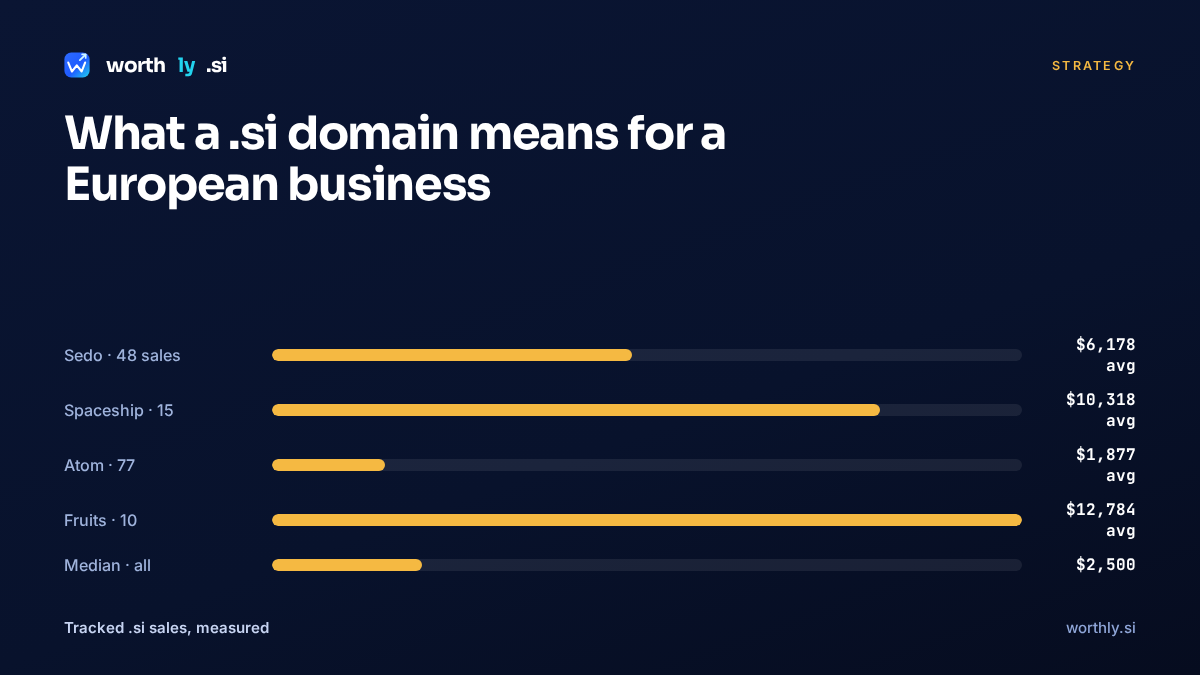
- The tracked record shows real money moving: 48 sales through Sedo averaging $6,178, and 15 through Spaceship averaging $10,318.
- Cheap renewals buy optionality, and optionality has value. A long hold also lets you wait for the one buyer who wants exactly that word.
The arithmetic does not condemn holding in general. It condemns holding without a thesis, a horizon and a floor.
One caveat that undercuts our own percentages: 197 of the 234 tracked sales are dated 2026 and 37 carry no date at all. Our sample is effectively one reporting window, not a long time series. Treat every break-even figure here as arithmetic you can redo, never as a measured frequency of the market.
The rule we use
Before registering anything, write two lines: the number of years you are willing to fund, and the sentence naming the buyer. Then run the name through the appraisal and read how the figures are built before treating the output as a forecast. If the arithmetic still works after you have priced in the years you will actually pay for, hold the name with conviction. If it works only because $11 felt like nothing, you are not investing in a domain — you are renting the feeling of having one.
Check a name while you are here.
Registry-accurate availability and a value range that shows its comparables — free, no account.