We are not a registrar and we do not sell domains. We check .si names against the Slovenian registry and track what they sell for, which is why European companies ask us one specific question: is a .si name a sensible home for a business, or a hobby extension. The answer turns on two registry rules that have nothing to do with price.
The registry is real, and it is European
.si is the country-code top-level domain of Slovenia, administered by ARNES, the national research and education network. It publishes registration data through a public RDAP service, so availability is not a matter of opinion — we query that service on every check and treat DNS as a second witness rather than the first, because a registry under load can answer in ways that mislead.
For a European company that has three practical consequences. There is no residency requirement: a company in Germany, the Netherlands or Spain holds a .si name on the same terms as a Slovenian one. The registry sits inside the EU, so the data it holds falls under European data-protection rules rather than a third-country regime. And because the registry publishes its own answers, you can verify a claim about a name without trusting a broker.
The rule that changes your paperwork: registrant contacts are ID-matched
This is the part worth reading twice. .si has no registry-provided privacy or proxy service. Registrant contact data is published, and the registry operates an identity-matching requirement: the registrant name and address you submit must match the identity documents behind them. That is a European compliance posture rather than a quirk — it is the direction EU policy has been moving, and it is now tied to NIS2-era obligations on registries to hold accurate, verified registration data.
Concretely, for a European company:
- The contact data on the domain is yours, not a nominee's. You cannot solve a privacy concern by registering through a friend or a proxy service, because there is no registry-level privacy option to buy.
- If your address changes and you do not update the record, you are carrying an inaccurate registration, not a small bookkeeping matter.
- Anything you would not publish — a director's home address, a personal phone number — should not be the registrant contact. Register in the company name, with a company address, and accept that it is visible.
- Anyone can look up who holds the name. For a business that already publishes an imprint and a VAT number, that is usually neutral. For a private individual holding names speculatively, it is a real cost.
We have not found a way around this, because there is not one at the registry level. The only honest workarounds are structural: hold the name in the entity you already publish in your legal notice, and keep the details current.
What a .si name costs a company
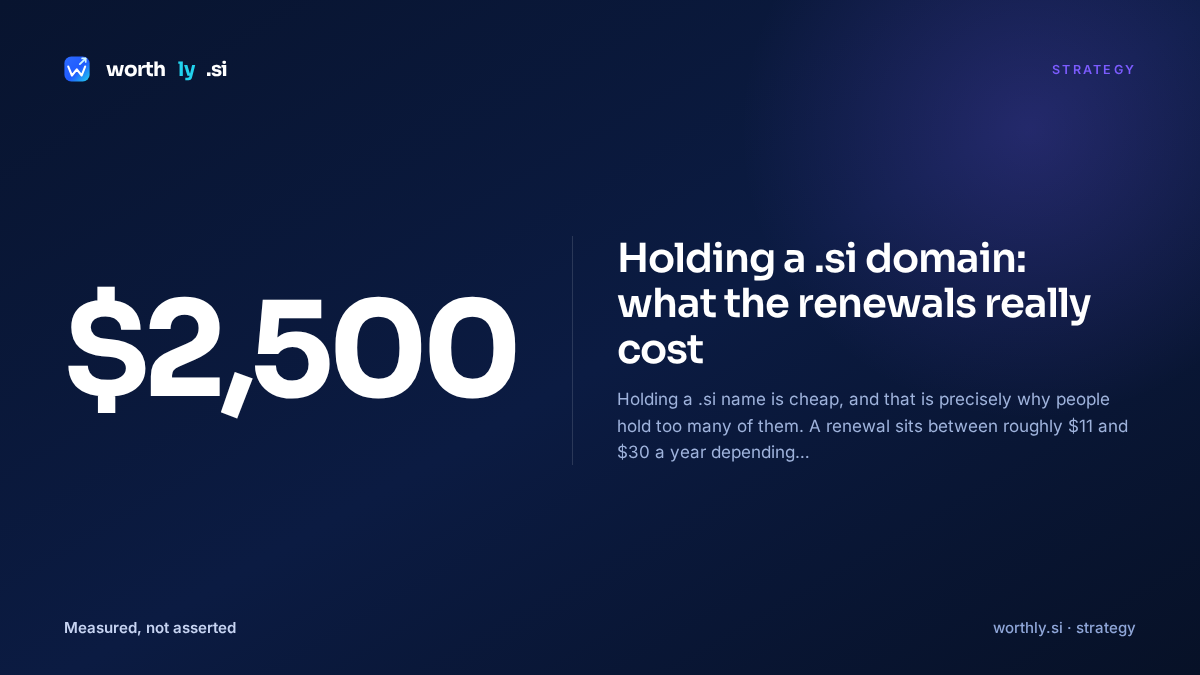
The holding cost is ordinary. Renewals run roughly $11–30 per year depending on the registrar, with no premium tier and no registry-side surcharge for being a business. Against that, here is the aftermarket as our tracked sales show it:
| Measure | Value |
|---|---|
| Tracked .si sales | 234 |
| Median price | $3,599 |
| Average price | $5,085 |
| Largest tracked sale | $50,000 — staffing.si |
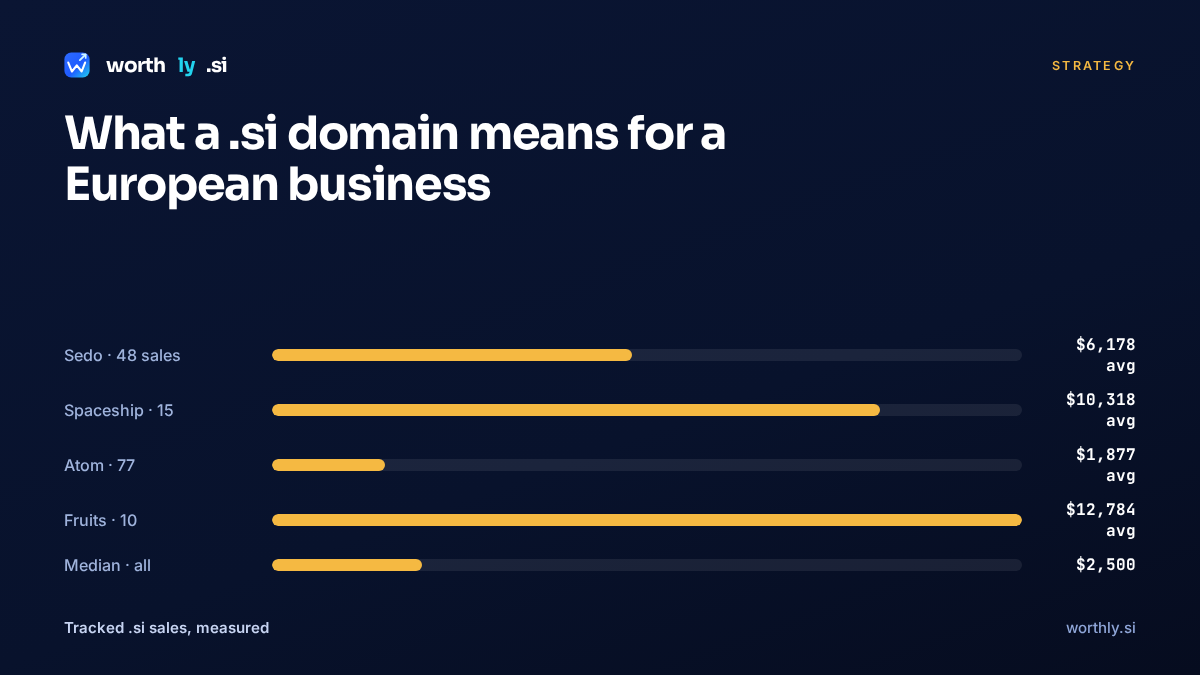
| Busiest venue | Sedo — 48 sales, averaging $6,178 |
| Second by volume | Atom — 27 sales, averaging $3,904 |
The gap between the median and the average is the useful part. A European company buying a name it will actually use is buying into the median, not the tail; the five-figure results are single dictionary words taken by companies with a brand to build.
Two further costs are routinely forgotten. Transfers between registrars follow the registry's rules rather than a marketplace's, and the .si aftermarket is small — 234 tracked sales is the entire visible depth — so a name bought to resell may take months to move. And if you want to check availability programmatically, the free API is capped at 60 requests per hour per IP, with one-time keys at $12 and $29 once that ceiling starts to matter.
Where a .si name is the right answer
- A European company whose name is a common word. If the
.combelongs to someone else's brand and the.euis gone, a short.sinames the product cleanly and renews for pocket change. - A technical audience. Developers read two-letter country codes fluently and do not need a paragraph of explanation before they type it.
- A company that wants its ownership on the record. With ID-matched contacts, a
.siregistration is a reasonably strong public claim — which is exactly what you want to be holding in a dispute. - A business that expects to hold the name for years. At $11–30 a year the holding cost never forces a decision, which is the whole advantage of a quiet extension.
Where it is the wrong answer
We would steer a company away from .si in four situations:
- Your customers are non-technical and arrive by typing. If someone hears your name once on the radio, an extension they cannot place is a leak. Buy the
.comor your own national ccTLD instead. - You need privacy on the registrant record. There is no registry privacy service and the ID-matching rule means the published record is the company's. If a visible address is unacceptable, this is the wrong extension, full stop.
- You are trading rather than trading from it. A liquid aftermarket is what makes a flip survivable;
.si's is thin. Patience is part of the position, not a nuisance to be optimised away. - Your brand depends on the country signal. A Slovenian ccTLD on, say, a German B2B firm is a small, permanent explanation. Sometimes that is fine. Sometimes it is a mismatch you will be repeating for a decade.
How we would decide
Name the buyer first. If the answer is "a European technical audience and we will hold this for ten years", .si is a good fit and the registry rules are an advantage: verified, published ownership and a renewal that never becomes a line item. If the answer is "consumers who must recognise us instantly" or "we cannot publish an address", those same rules are the reason to walk away.
Check the name against the registry on the free availability check, compare what similar names actually sold for in the tracked .si sales index, and read the range on the appraisal page — it prints its comparables and its arithmetic, so you can argue with the components instead of the total. If you would rather buy a name that already exists than start from scratch, the owner-verified names we list are all descriptive business words, which tells you who is buying here.
Check a name while you are here.
Registry-accurate availability and a value range that shows its comparables — free, no account.