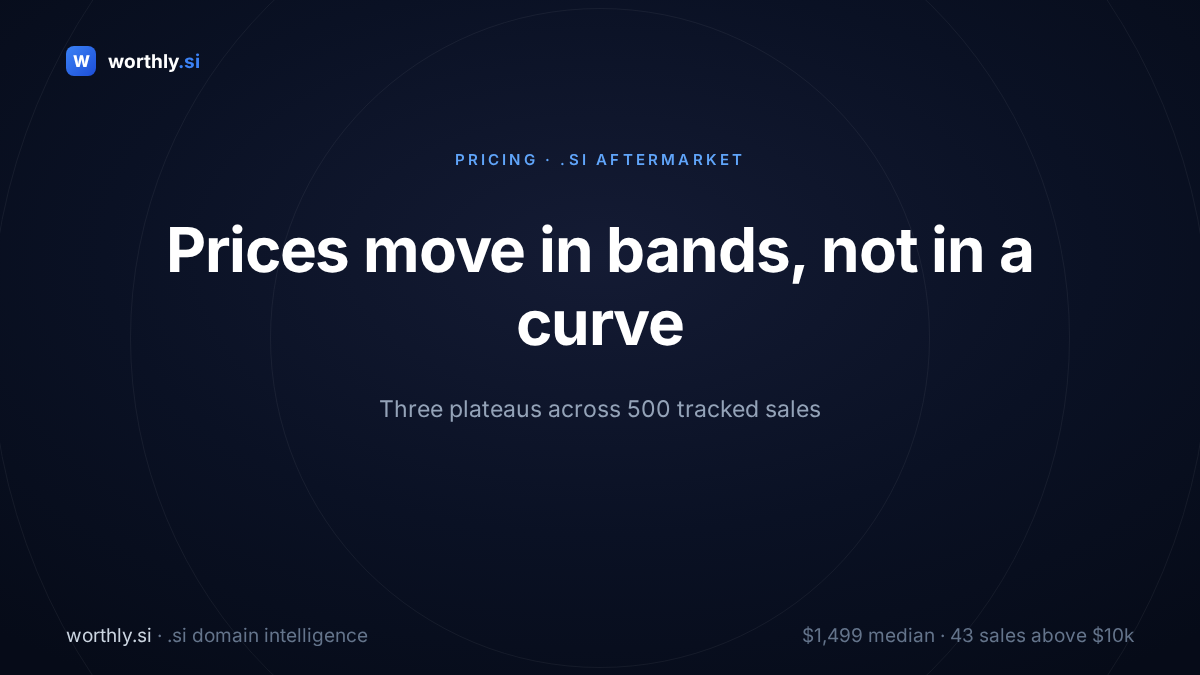
Take the 500 tracked .si sales, sort them by price, and you expect a smooth curve — most names cheap, fewer names expensive, a long tail at the top. That is not what the numbers do. They form three plateaus with thin bridges between them, and understanding those plateaus is more useful than any single average.
The measured shape:
- Floor: up to about $500 — 214 sales, 43% of the sample.
- Middle: $1,000 to $9,999 — 243 sales, 49% of the sample.
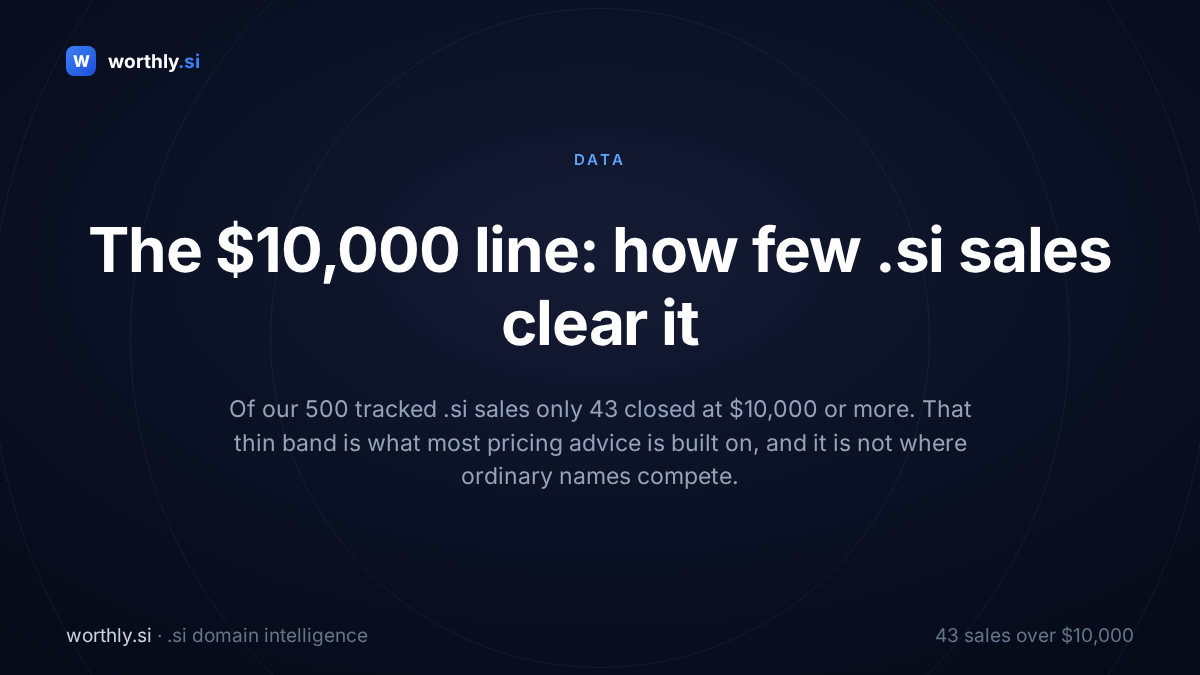
- Top: $10,000 and above — 43 sales, 8.6% of the sample.
Between $500 and $1,000 there are only 59 sales in the entire dataset — the thinnest stretch in the distribution, and the band where most overpriced names end up parked.
Why the gaps exist
Buyers do not shop continuously along a price axis. They arrive in three moods, and each mood has a budget attached to it before the name is even chosen.
A buyer at the floor is buying inventory. They evaluate names in batches, care about wholesale multiples, and will not pay $800 for a name they intend to resell at $2,000 six months later. Their budget is a per-name ceiling, not a total.
A buyer in the middle is a small business that needs a name this week. They have already decided the name is part of the product, they have a rough budget from a founder or a marketing line, and they compare your price to the cost of a redesign or a paid acquisition campaign — not to other domains.
A buyer at the top is a company with a budget and no urgency, or a broker acting for one. They are not shopping for a name so much as confirming one they have already chosen, and the price is a rounding decision next to the legal and branding work.
Those three buyers never compare notes. A reseller will not stretch to a founder's price, and a founder will not spend six months hunting for a $200 alternative to a name they like. The gaps in the distribution are simply the prices at which no type of buyer is shopping.
What lives in the dead zone
Names priced between $500 and $1,000 are almost always names whose owner thought the number looked modest. To the reseller, the name is too expensive to flip. To the founder, it is expensive enough to require a justification and cheap enough to suggest there is no reason to give one. Both sides negotiate from weakness, and the listing sits.
The same trap catches names at $5,500 — just over a band, just far enough from a round number to look like a negotiation position rather than a price. Our sample has 81 sales between $5,000 and $9,999 and only 28 between $10,000 and $24,999, so the traffic thins sharply the moment you cross the line.
How to place a name in a band
Three checks in this order, each one moving the name by roughly an order of magnitude:
- Is it a single dictionary word or a one-word category? If yes, it competes at the top. If it needs a sentence to justify it, it does not belong there at any price.
- How many other extensions is the string registered in? Thirty-plus TLDs means global demand for the string itself. One or two means the string is a local idea, and it prices accordingly.
- Is there a trademark in the buyer's category? Not anywhere in the world — in the market the buyer sells into. A conflict there sets a ceiling no marketing budget can lift.
Answer those three and the band is decided. What remains is position within the band, which is where listing quality, artwork, and the evidence you can put in front of a buyer actually matter.
Why the middle is the best place to be
Portfolio holders talk about the top because the top is where the stories are. But the middle holds 243 of 500 sales — half the market — and it clears in weeks rather than years. A name priced at $2,400 with a clean brand, a defensible category and a working transfer path sells to a founder who is comparing it to a two-week design sprint.
The middle also has the widest range of acceptable prices. A name can move from $1,600 to $3,800 without leaving the band, which gives a seller room to negotiate without ever appearing to panic. That flexibility is worth more than a five-figure ask you never collect.
The objection: does this mean aiming low?
No. It means aiming inside a band a buyer is already shopping in. The failure mode is not ambition, it is aiming high with a name that belongs in the middle, waiting eighteen months, and discounting in public — which teaches every buyer watching that your first price was a position rather than a valuation.
Price the band, then earn your way to the top of it with evidence: extensions, trademark clearance, search volume, and a buyer who has already asked. What you should not do is skip the middle by pretending it is not where the name lives.
What this changes in practice
If you are listing a portfolio, group the names by band before you set a single price. Price the floor names to move, price the middle names to sell within a quarter, and put only the one-word category names in the top band — then renew those deliberately, because they are the ones worth waiting on.
The 43 sales above $10,000 will keep being quoted, because they are dramatic. But 457 of the 500 sales that actually happened were below it, and a portfolio that understands those 457 will outperform one that prices everything like it belongs to the 43.
Check a name while you are here.
Registry-accurate availability and a value range that shows its comparables — free, no account.