Most of what circulates about .si drops is imported from .com, and almost all of it is wrong for Slovenia. The real rules are short, published, and readable in ten minutes.
What the registry actually says
.si is Slovenia's country code, run by ARNES and operated under the Register.si name. The governing document is the General terms and conditions for registration under .si, in force from 15 November 2024. Four clauses settle expiry:
- Clause 5.3.2 — without a renewal request, the name is given "quarantine" status on the date of expiry. The clock starts on the expiry date, not weeks later.
- Clause 5.4.2 — quarantine removes the name's pointers from the .si top-level DNS, so the site and mail stop working, and lasts "no longer than 30 days".
- Clause 5.4.3 — without renewal the name is deleted after 30 days and may be registered again; a renewal removes quarantine and reactivates it.
The registry's own guidance page calls the same window "pending delete" while the Terms call it quarantine: same 30 days, two labels, and a common source of confusion.
.si against the familiar gTLD cycle
| Stage | .si | A typical gTLD |
|---|---|---|
| Immediately after expiry | Quarantine begins on the expiry date | Auto-renew grace period, up to 45 days |
| DNS during the window | Pointers removed; the name stops resolving | Often still resolving for part of the window |
| Redemption or restore stage | None defined in the Terms | 30-day redemption, restore fee |
| Separate pending-delete stage | None defined in the Terms | 5 days, with no recovery |
| Expiry to release | Up to about 30 days | Up to about 75 to 80 days |
Read the right-hand column as contrast only: that framework is written for gTLDs under ICANN contracts, and nothing obliges a ccTLD to follow it.
The route that skips the window
Clause 6.2.2 lists deletions that happen without intermediate quarantine: a binding court decision, a decision in the registry's dispute procedure, a holder's breach of the Terms, and the cases in clause 11.3. Read that last one in full — a holder may ask for their personal data to be blocked or deleted, and if they do, the registry deletes all domain names that holder registered. There is no privacy proxy to buy at the registry and no partial anonymisation: on .si you are either identifiable or you are gone. That follows from the EU and NIS2-era expectation that a registry knows who holds a name, and because those deletions skip quarantine, a name can leave the register on a shorter clock than the standard cycle suggests.
Knowably true, and folklore
True, and checkable against the Terms:
- Quarantine starts on the expiry date and lasts no longer than 30 days (5.3.2, 5.4.2).
- The holder can still renew during quarantine, and a renewal reactivates the name (5.4.3). "Pending delete" does not mean abandoned.
- Registration is automated and first-come, first-served, in the order the registry's server accepts applications (5.2.1).
Folklore, or true only under conditions:
- "It sits in a redemption period, like a .com." The Terms define no redemption stage and no restore fee. Two states are in play: registered, or in quarantine.
- "ARNES auctions expired names." The registry does not sell to holders at all: clause 10.3 says ARNES takes payment only from registrars and will not accept payments from domain name holders, and clause 9.7 says it "will not offer, sell or market goods or services". The auctions around drops are run by registrars and backorder services.
- "There is a published drop list, and a drop time." We could not find either: no list of names due to drop, no purge hour. Published drop lists are a gTLD-style artefact. What exists per name is RDAP at rdap.register.si, which returns a status field plus the registration and expiration events. And you cannot build a bulk list by querying WHOIS or RDAP: both the registry's terms of use and the RDAP notices forbid copying, extracting or publishing those databases, whatever the technical feasibility.
- "Sixteen days to hand a domain back." Clause 12.1 is a consumer withdrawal right, 14 days from a distance contract, and clauses 12.1.1 and 12.1.2 add the registry's conditions: the deletion request must reach it within 16 days of registration and the name must not have been activated, activation being the moment its name servers are entered. A name that has been live is not returnable.
- "WHOIS hides you." Clause 13.3 publishes only an email address where the holder is a natural person, with more disclosed on request under clause 11.6.4 and a form that requires a documented ground. That is a modest default, not a privacy product.
An honest playbook for watching a drop
- Watch names, not lists. Keep a short list you actually want and check each through RDAP at a civil rate. With no lawful bulk feed, selectivity is the lever, not volume.
- Anchor the window on the expiry date. Deletion comes after the expiry of 30 days (5.4.3) and no hour is published, so plan a window rather than a timestamp. Anything claiming a precise .si drop minute is guessing.
- Expect the name to survive. The holder can renew throughout quarantine, so the most common result of watching a name is that it never drops. Watching is a low-yield activity by design.
- Be in the race through a registrar. Registration is registrar-mediated and first-come, first-served, so being in the race means a backorder or drop service, on its own terms and fees. Our tracked data records six sales through backorder auctions, averaging $3,468 with a largest of $5,800 — real money, and a narrow sample.
- Price it before you commit. The median tracked
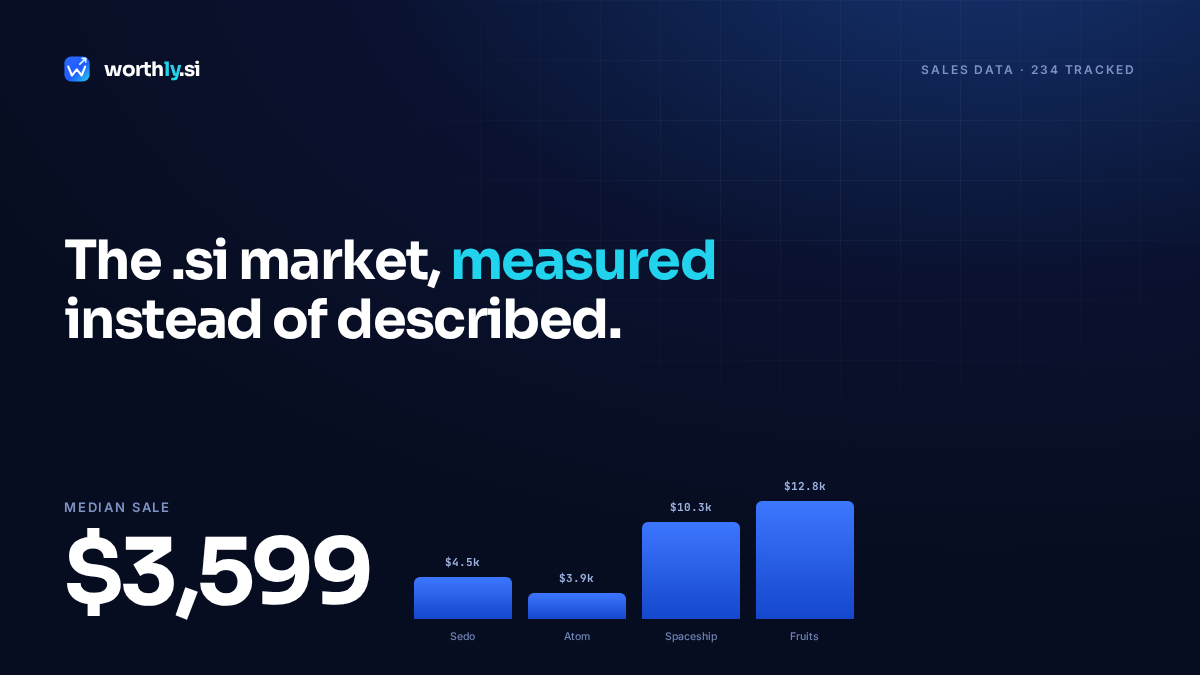
.sisale is $3,599; our plainest auction venue averages $532 across 10 sales. If a contested drop passes those numbers, you are buying conviction rather than following data. - Do the diligence before the drop. A dropped name usually had a live site, so it may carry history and claims you did not create: a complainant under the registry's dispute procedure must show confusing similarity to a Slovenian trade mark, company name, copyright, geographic designation or personal name, that you lack legitimate interest, and registration or use in bad faith. A dictionary word matching someone's brand is the case to check first — the appraisal shows what the same string is doing in other extensions.
What the drop market cannot tell you
The sample is the limit. We track 234 .si sales, 197 dated 2026 and 37 undated, and we cannot say what share of expiring names are renewed, how many drop each month, or whether drop competition is rising. The registry publishes registration totals; we could not find it publishing deletion counts, and no venue exposes contested-drop volumes. So we print no drop-rate figure at all: with six tracked backorder-auction sales, that bucket is anecdote with a price tag attached.
Which leaves a 30-day window in clause 5.4.2, no redemption fee, no registry auction, no published list, and a market thin enough that patience costs little and certainty is not on offer. Check a name in the tracked sales index before you bid, and read how our figures are built so you can discount them correctly.
Check a name while you are here.
Registry-accurate availability and a value range that shows its comparables — free, no account.