This is the unromantic version. Most .si names do not sell, the market is small enough to count, and the sellers who get paid are the ones who price from the record instead of from a feeling. Here is the process, in the order it happens.
First, the size of the room
Our tracked market is 234 sales, which is every .si sale we could verify and record. Of those, 197 were reported in 2026 and 37 carry no confirmed date, and 87 were logged without naming a venue at all. A market that fits in one database cannot be forced. Plan to hold the name longer than you would like.
Second, decide what number you actually want
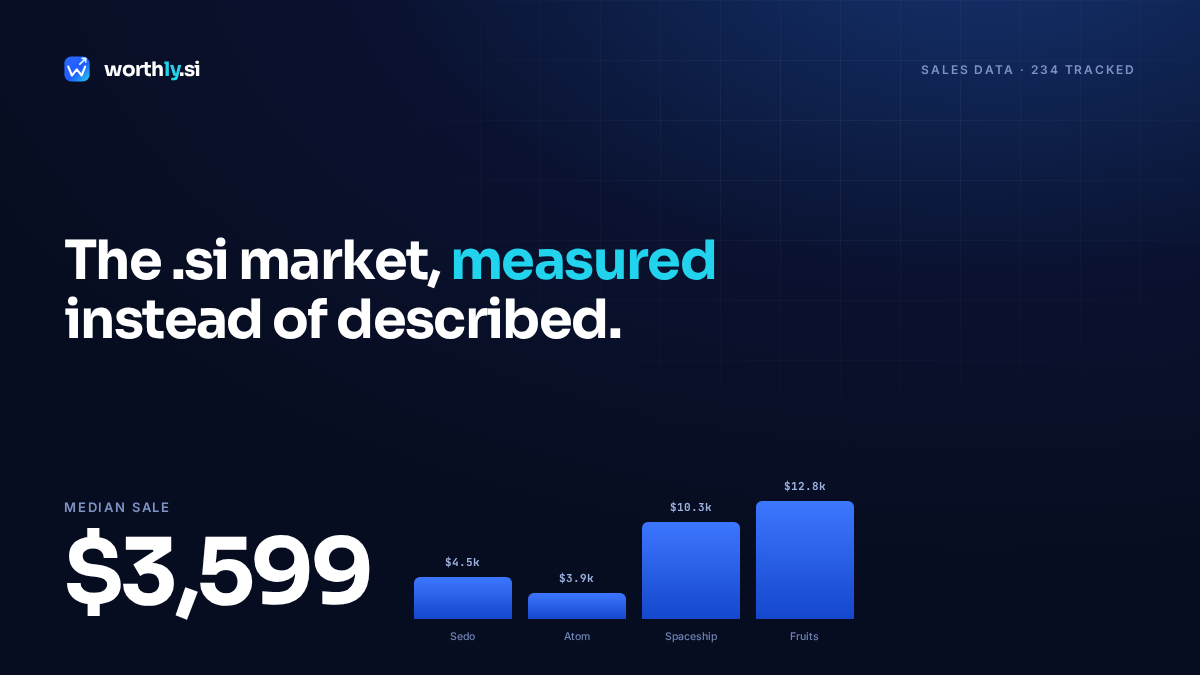
Anchor on the median, not the average: $3,599 against an average of $5,085. The gap exists because a short tail of five-figure deals, headed by $50,000 for staffing.si via Spaceship, pulls the mean up. If your name is not a single dictionary word or a word a business would build on, the median is the honest target and the average is a story you tell yourself.
Set a floor in writing before you list, in one sentence you can defend: "It is a two-letter word in a growing category, sales at that length average $6,736, and my renewal is $11 a year." Then publish the appraisal beside the price, so the buyer argues with evidence rather than adjectives.
Third, pick the venue for the outcome you want
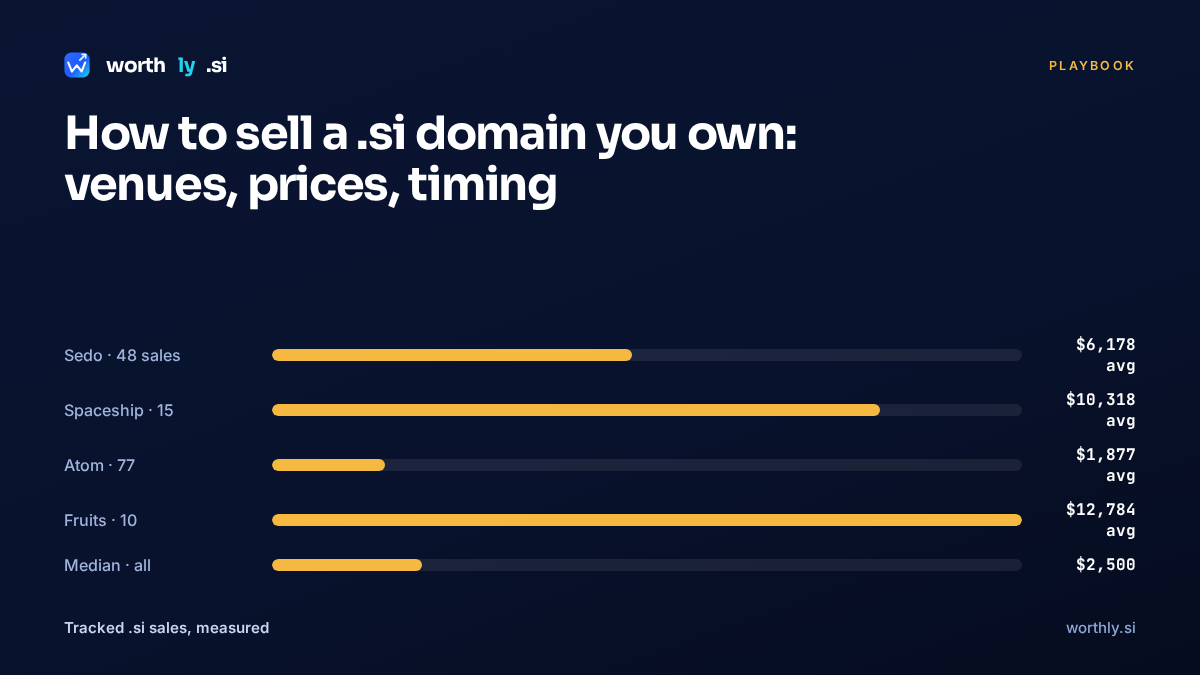
The venue decides who is in the room, and the recorded averages differ sharply:
| Venue | Sales | Average | Largest |
|---|---|---|---|
| Sedo | 48 | $6,178 | $30,000 |
| Atom | 27 | $3,904 | $14,870 |
| Spaceship | 15 | $10,318 | $50,000 |
| Fruits | 10 | $12,784 | $31,346 |
| Private | 20 | $3,027 | $23,000 |
| Auction | 10 | $532 | $2,000 |
| Dynadot | 8 | $2,363 | $7,250 |
| Backorder auction | 6 | $3,468 | $5,800 |
| Dynadot auction | 3 | $858 | $1,075 |
Read that as a map of effort, not a ranking of quality. Sedo and Atom move volume at moderate prices. Spaceship and Fruits produced the top of the range on a fraction of the sales. Auctions averaged $532 across 10 sales, which is the clearest evidence in our data that a no-reserve auction is a way to be paid quickly rather than well.
Small counts deserve a warning: Dynadot's 8 sales and the auction formats' 3 to 10 sales are too few to separate a venue's skill from the names that happened to pass through it. With 87 sales recorded without a venue, this table shows where sales were visible, not where all sales happened.
A note on matching the venue to the name
The pattern in that table suggests a simple mapping. A single dictionary word with commercial intent belongs in front of a curated or high-end channel, where it can wait for its price; the same name in a general auction discovers the floor, not the ceiling. A longer service word with obvious intent sells best where buyers search by keyword, which is why a keyword marketplace with a firm fixed price tends to outperform a countdown here. If you need the money this quarter, accept that an auction clears at an auction price, which in our record averaged $532.
Fourth, list where buyers already look
Two things bring a .si buyer to a name: a marketplace listing, most often Sedo or Atom, both of which clear .si regularly, and a public index a buyer can search. Our for-sale page lists owner-verified names with Atom make-offer links, the shortest path from someone wanting the name to someone bidding on it. Keep the listing honest: state the price or a floor, state how payment works, and answer questions within a day.
Fifth, handle the handover properly
This is where deals fall apart. Move the money and the name together, and make the sequence explicit before anyone starts:
- Agree the price and the currency in writing, and name the escrow service the buyer will use.
- Have the buyer fund escrow first. You release nothing until it is confirmed.
- Run the handover registrar to registrar: the buyer starts the transfer at their registrar and you release the name with the code your own registrar issues.
- Say early that the registry offers no privacy protection on .si under the EU identity-matching rules, so the registrant stays publicly visible during and after the transfer.
A buyer who discovers that last point late walks away, and the deal usually dies with it.
Sixth, on timing
A .si renewal costs roughly $11–30 a year. That asymmetry is your whole advantage: a name that does not sell this month costs a few dollars to hold, while a name sold under pressure costs a permanent discount. The rational play is a realistic floor, a long listing, and no auction you did not choose. If the name is genuinely weak, letting it go is a fine outcome too, and better than cutting the price until the number matches your impatience.
What we cannot promise
Nobody can tell you your name will sell. On this record most will not, and 87 of 234 sales arrived with no venue disclosed, so even the map above has holes. What we can do is keep the record honest: every figure on this page comes from the same database you can filter on the sales index, the reasoning behind each valuation is printed on the appraisal, and how it works shows our sources. Price from that, hold patiently, and take the deal that clears your floor.
Check a name while you are here.
Registry-accurate availability and a value range that shows its comparables — free, no account.