Most weeks we receive some version of the same message: a screenshot, a claimed comparable, and an asking price. Screenshots are not evidence, and a comparable without a venue and a date cannot be checked by anyone. The difference between a .si claim and a .si fact is that facts are published by the registry, where you can read them before you pay anyone anything.
What a broker email can and cannot tell you
- It can tell you that a name exists, that somebody is offering it, and what they are asking.
- It cannot tell you what the name is worth, what a comparable genuinely sold for, or whether the person writing owns it at all.
None of that makes brokers useless — they are how most names change hands. It means their claims are inputs to your decision, not findings you can build on.
What the .si registry publishes, and to whom
.si is Slovenia's country-code domain, administered by ARNES, the national research and education network. Its registration data is available through public RDAP: a lookup any browser can run, with no account, no fee and no explanation required. That changes where a negotiation starts. You do not need the seller's cooperation to learn whether a name is registered, when it was created, what status it holds, which nameservers serve it, and who the registrant is.
- No residency requirement. Any buyer may hold a
.siname, so pressure framed around eligibility is not describing a registry rule. - No registry privacy shield. Unlike extensions where anonymity is resold as a product,
.sidoes not layer privacy protection over the registration record, and the EU identity-matching obligations in force mean the record points at a real holder. A seller reachable only through an anonymous address is making a choice, not following the registry's requirements. - Renewals of roughly $11–30 a year. The cost of holding a
.siname is small and knowable, which matters when a message implies you have an hour to decide.
How much of the tracked market is even attributable
Registry data confirms that a name exists. It never says what a name is worth, and the place people look instead is sales records — including ours. So it is worth being honest about how strong those records are. Our index tracks 234 .si sales, attributed like this:
| Venue | Sales | Average | Largest |
|---|---|---|---|
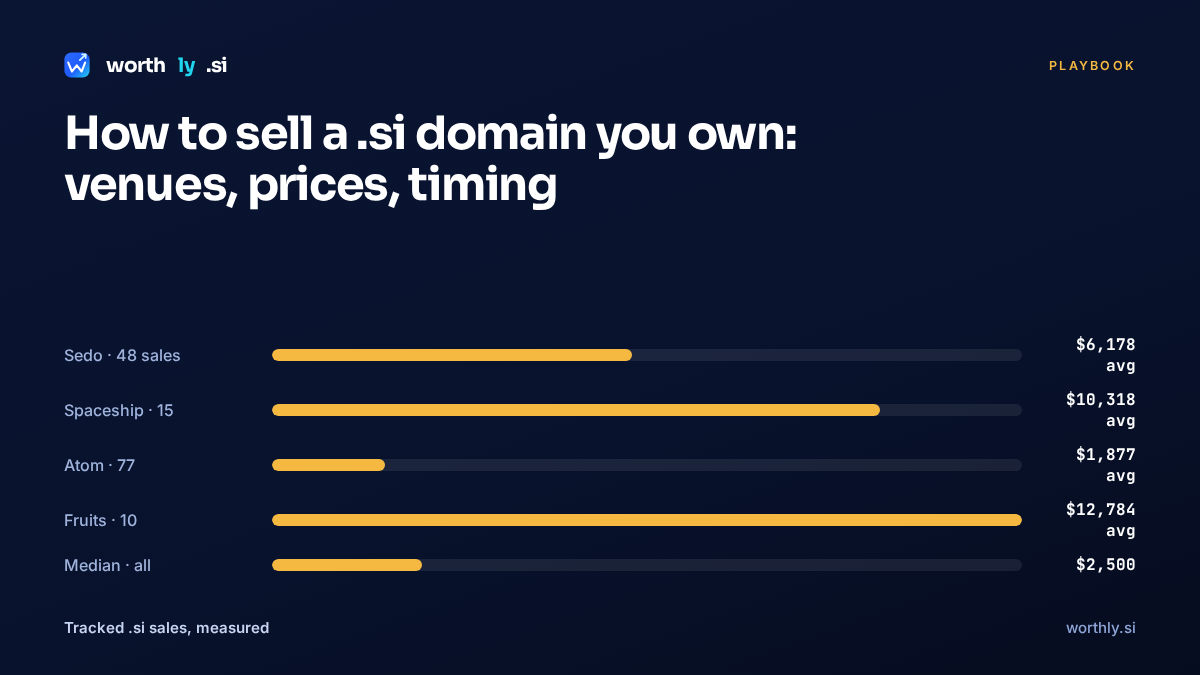
| Sedo | 48 | $6,178 | $30,000 |
| Not stated | 87 | $4,565 | $20,000 |
| Atom | 27 | $3,904 | $14,870 |
| Private | 20 | $3,027 | $23,000 |
| Spaceship | 15 | $10,318 | $50,000 |
| Fruits | 10 | $12,784 | $31,346 |
A named venue appears for 127 of the 234 tracked sales. 87 disclose no venue at all and 20 are recorded only as private: 107 sales, just under half the set, where a buyer has no way to verify the transaction independently. A broker's comparable with no venue and no date lives in that group. So does a good deal of our own index, which is why we mark those rows rather than dropping them.
Verifying a .si name yourself, in five steps
- Pull the registry record first. Look the name up through our home page, which queries the registry directly, or query ARNES yourself. Confirm it exists, along with its status, creation date and nameservers, before anyone mentions a price.
- Check the nameservers as a second witness. A name with live nameservers and working mail records is an operating asset. A name with neither is a shelf name. Both are public, and both beat any screenshot.
- Ask for the comparable in full. Name, price, venue and date — then look it up on the sales index. A comparable that is not there, or that carries no venue, is unverifiable rather than necessarily false, but it should not move your offer.
- Compare against the median, not the average. The tracked median is $3,599 and the average $5,085. That gap is a handful of five-figure sales; the average describes a market most names never join.
- Demand the arithmetic in public. A price you are asked to accept should arrive with its comparables, its adjustments and a confidence level you can inspect. That is what our appraisal prints for any name, and what the method page publishes line by line, precisely so that you can disagree with it.
Three claims we would not accept without evidence
- "The owner is anonymous." On a
.siname the registry record is the owner's record; there is no privacy layer to hide behind. - "A comparable sold for five figures." A price with no venue and no date cannot be checked by anyone, including the person quoting it.
- "You need to decide by Friday." Holding a
.siname costs roughly $11–30 a year. Urgency is a sales technique, not a renewal deadline.
What registry data cannot do
Worth stating plainly, since we publish both sides: registry data proves existence, status and control. It has no opinion about value and cannot tell you whether a name is worth buying. That question belongs to sales records, and those records are thin — 234 sales across the whole aftermarket, with a venue named for barely more than half of them. Neither source is sufficient alone. The registry stops a seller from misdescribing what they hold; the sales index stops a buyer from pricing a name off a story. Use them in that order, and the figure you end up defending is one you can actually show someone.
Check a name while you are here.
Registry-accurate availability and a value range that shows its comparables — free, no account.